Singapore is a Chinese majority city state. The Chinese DNA always consists of Confucian and Taoist philosophy (儒道互补). In a broader definition, educated Chinese have three teachings (儒释道) of Confucianism, (T/)Daoism and Chinese Buddhism.
One may wonder, after 50 years of bilingual education and English (/Singlish) as our first language, whether Singapore Chinese still have these DNAs. Yes. I think so, perhaps, the word ‘Endurance’ indicating such a DNA.
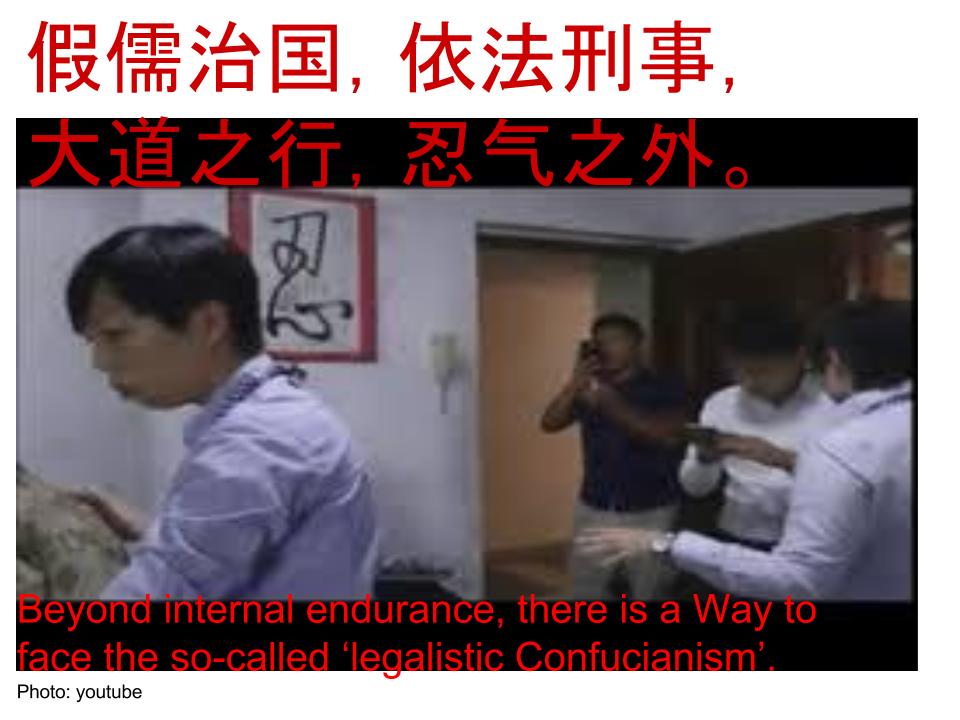
The PAP government stresses our Asian origins and promotes Confucianism amongst Chinese Singaporeans. However, in many ways, they are practising ‘Legalist’ (法) administration. In the above picture, the police was shown raiding the house of Teo Soh Lung after the Election Department filed a complaint to the police about her by-election offence.
The details were well reported in mainstream and social media.
In the name of Confucianism, the PAP government and the police are acting like a ‘Legalist’ - imposing strict law even without proper identification.
In defence, political and social activists can only endure such actions helplessly, effortlessly.
[Beyond endurance]
Endurance (忍) appears in the Three teachings (儒释道).
In Chinese history, Confucianism and Taoism always compliment each others (儒道互补). All ancient Chinese scholars had these personalities. Even in communist China or democratic Taiwan, political leaders there still maintain these characters. When one is appointed an official, his Confucian personality appears. When one is down or demoted, his Daoist (or Buddhist) character shows up.
Throughout Chinese history, Taoism always goes side-by-side with Confucianism. Sometimes they act in concert but sometimes they compete against each other.
[Does it matter to Singapore politics?]
Singaporean Chinese, even the young ones who are less hungry (claimed by DPM Tharman), still have these Ru-Dao (儒道) personalities. Legalistic Confucianism as practised by the PAP can be seen everywhere everyday and needs no further explanations. It represents the ‘Yang’.
And Taoism represents the “Yin” - nature (environment), mothers (Mother’s Day), baby (Children’s Day), ‘Kiasi’, weak, soft, etc. It can also extend to activities like Tai Chi, traditional Chinese medicine, Chinese temples (religious Taoism), etc.
So, Daoism is not foreign to Singaporeans. It provides alternative way or opposite way. It even offers a third way (right, wrong and in between).
The PAP has already occupied the ‘Yang’ activities. Singaporeans do believe the PAP can deliver and the oppositions cannot match them. Continuing using ‘Yang’ tactics, e.g. better policies, better management, will be less effective in attracting votes.
There was a time the PAP neglected their grassroots and feedbacks from Singaporeans. However, it now shifts to democratic socialism, towards the ‘Yin’. They seem to adopt Confucianism-Daoism complementary. (儒道互补)
Is there a room for oppositions in Singapore? Besides endurance, what can oppositions do? The PAP will always be a ‘Yang’ party and engages in ‘top-down’ approaches. To offer different things, oppositions may have to offer ‘Yin’ solutions and ‘bottom-up’ approaches. However, it is not an easy task. Voters believe the PAP can shift from right to left and then back to centre. They don’t believe the oppositions can do the same.
Singaporean’s pragmatism will always give the PAP an edge over oppositions even voters know the election is not a fair game . Moral judgement, value judgement, checks and balances will be assessed in a practical way.
Besides endurance, retreat, re-think, regroup and even absent (meditation) are some ‘ways’ to consider. It needs wisdom as Dao (the Way) is a higher Chinese philosophical thinking.
[Does it matter to new WP leadership?]
The long-term survival and sustainability of a political party is whether it is represented in the parliament. A long period of absence will make the political party irrelevant.
The recent election of Workers’ Party leadership is not so much of whether it is a democratic election or not. It is a matter of survival, sustainability and expansion.
Whoever
leads the WP will have to find the Way for the party, for Singapore.
Look at the Sarawak state election and the twin by-elections in
Malaysia, it is really not an easy way.
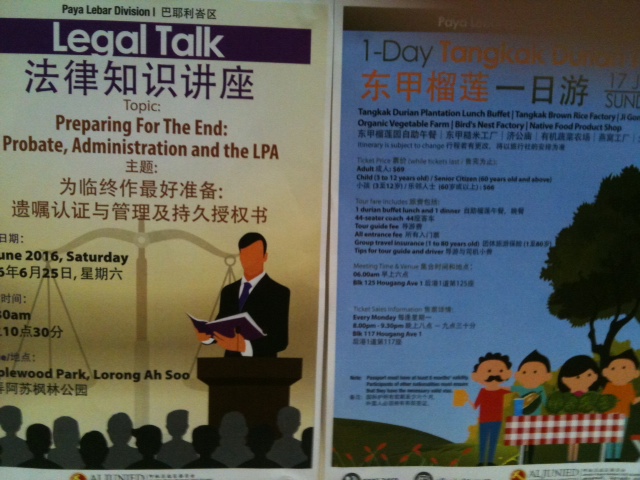
The traditional way of grassroots activities, like legal talk, one-day tour may not be enough. How can we find a better and alternative way? More people will have to contribute their brains and sacrifice their time to help the oppositions. Is this a dream or a way?
Comments
Post a Comment