2015 PAP Strategy 战略 20 -- state machinery
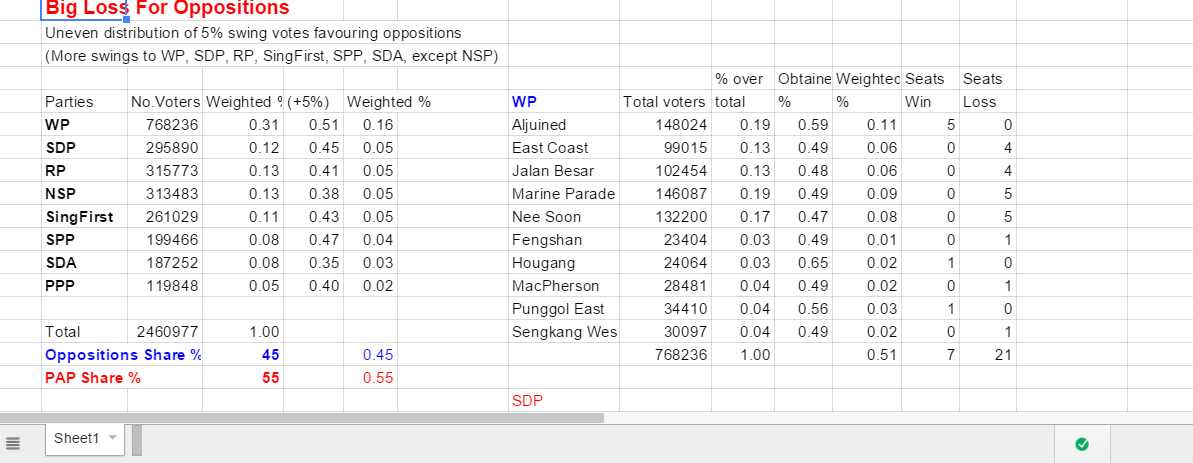
Even if the oppositions is managed to gain 45% of the total votes in GE2015, it does not mean a big win. Instead it can still be a big loss, a big disappointment.
If you present it in a spreadsheet, even the Workers’ Party improves its vote share to 51% (i.e. WP 51%, PAP 49% in all WP contested seats), there is still no breakthrough for WP. What a big disappointment!
The following table provides the possible picture of the ‘big disappointment’:
You can see the full spreadsheet here: https://docs.google.com/spreadsheets/d/1rqLUI2z8sJykCG0EXNRiOIUbpVVNZ4DOC1H9mP5R-8A/pubhtml
https://www.scribd.com/doc/277075659/GE2015-Prediction-Uneven-Distribution
Power yourself with the prediction
You can even treat the spreadsheet as a political game that you can adjust the percentages for each constituency that opposition parties will obtain. If you think Party A should get more votes, you just increase the percentage and see the overall result.
You can also predict the PAP will win 60% of the total votes and WP will lose more seats. Alternatively, you are very confident of a big win for the oppositions, you can adjust the spreadsheet accordingly. But be realistic!
PAP is more powerful than what you can think of
This spreadsheet of GE2015 prediction is very a low tech tool if you consider the state machinery of the PAP. Over the past 50 years, the PAP has invested many resources, hardware and software, in predicting the outcome. With the advancement of technology, this becomes more sophisticated and comprehensive. They can even predict the outcome when you visit their sites or download their apps.
Considering the followings:
- PAP has supercomputer and big data analysis experts.
- Every results of every polling districts of GE2011 and PE2011 can be easily input into the computer.
- New data like boundary redrawing, changes and new voters are added for latest adjustments and analysis
- Computer modelling can predict the outcome for different issues, change of policy, mood change, feedback etc. SG50, National Day Parade and Rally, Medishield, Pioneer package, Baby bonus, all have already input into the computer.
- And many more advices from their foreign and local consultants.
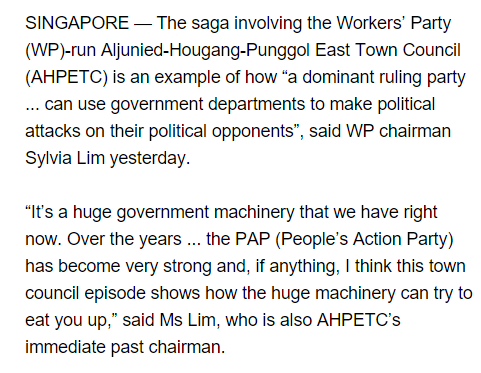
It is similar to TODAY’s report on the eve of Nomination Day:
Episode shows how dominant party can ‘eat up’ opponents, says Sylvia Lim
The PAP is doing the analysis every day or even every hour, from subject to subject or constituency to constituency. For example, the AHPETC issue, when Ministry of National Development issues a statement, what is the response in the ground, in particular inside and outside Aljunied, Hougang and Punggol East. It may have little impact inside and big impact outside.
Little inside impact means WP can keep the 7 seats but WP is not able to win any seat outside AHPE as there is a big impact outside.
When the nomination is closed, new issues will appear. In Ang Mo Kio GRC, national issues, like CPF, population, human rights will be raised. The PAP may have to shift their focus from the regional issue of AHPETC to jobs, CPF, Singapore Core, citizen engagement etc. This is a national election, the PAP will have to discuss and defend their national policies.
Of course, the PAP can also ignore national issues as they see WP is their only threat. WP is the only party that can match the PAP challenges and obtain 50% or more votes in WP contested constituencies. So, if you can put down WP, even with a small win in other non-WP contested constituencies, the PAP will win big in GE2015. This is why Dr Ng Eng Hen is so confident that when he talks about ‘ALL 89 seats’ win in this election.
89 may not be realistic but 89-7 is possible. This is the PAP’s target.
For opposition supporters, if we don’t like to receive a big disappointment, we need to put in more efforts, convincing more voters to vote for change.
However, let relax and do some exercises, play the spreadsheet game before our long march to deny PAP two-thirds majority in the 13th Parliament.
Here are 3 selected TCM physical exercises for the preparation to empower your future.
(You may not understand Mandarin but the exercises are self-explanatory).
Comments
Post a Comment