Judging from the quick announcement of the PAP candidate, the by-election in Bukit Batok single member constituency will be called sooner than expected.
This will be a contest between a reluctant candidate from the PAP, Mr. Murali Pillai and a committed candidate, Dr Chee Soon Juan of SDP.
Being a Paya Lebar voter, I see Mr. Pillai as a reluctant candidate and certainly not a committed candidate. In politics, I have great doubt he is as committed as his father, former ISA detained unionist, P.K. Pillai.
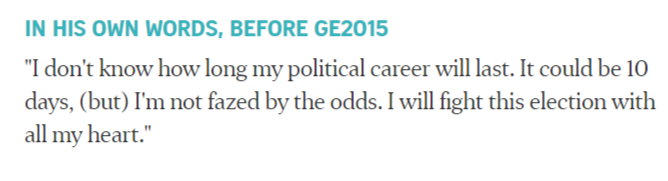
Source: http://www.straitstimes.com/
Cynthia Phua, his predecessor in Paya Lebar, was really a committed and hardworking person. And I also believe what she said below is true:
[If she were still an MP, Madam Cynthia Phua would have been absent from her father's side when he died.
"So I'm glad I was able to take care of him in his last days, after doctors diagnosed him with stomach cancer in late December.
"If I had been working as an MP, I would not be able to care for him," she said.]http://news.asiaone.com/News/Latest+News/Singapore/Story/A1Story20120510-345111.html
Why I say Mr. Pillai is a reluctant candidate?
The PAP claims he is a ‘very strong’ candidate and yet he is not the team leader of the Aljunied PAP team. He came to Paya Lebar just because the PAP wanted to form a GRC team. He did not show his leadership quality in GE2015.
As a professional lawyer, commanding more than 100 lawyers as claimed by Lim Boon Heng, he knew in advance his chance of winning in GE2015. If he were standing in Bukit Batok in 2015, like in this by-election, his winning chance was definitely higher. His winning percentage will also be higher than David Ong as he is more credible and qualified than Ong.
I wonder why he came to Paya Lebar as a candidate in 2015. Mr Pillai must be a reluctant candidate. He came here just because the party needed him to put up a show in Aljunied GRC. Now, the party needs him to put up another show in Bukit Batok.
Bukit Batok voters need to think twice before supporting such a reluctant candidate - not because of his race, but his political commitment.
You are now given a chance to vote in a committed Dr. Chee who will certainly give alternative views in Parliament. While a reluctant candidate, like Mr.Paillai, will be the usual PAP yes-man in the Chambers.
It may be hard to accept Dr. Chee for most of BB voters as he is not a perfect man, so do all of us. However, his commitment to democracy, checks and balances, transparency and accountability is beyond doubt. Mr. Pillai will listen to his party instruction if he is elected.
SDP contested in Paya Lebar and Bukit Batok in 1988 and obtained 47.64% and 44.06% of the votes respectively. In 1991, SDP even obtained 48.18% of votes in Bukit Batok. If not because of the GRC system, boundary re-drawing and internal problems, ...
Voters in Bukit Batok can make a change, just like the voters in Aljunied.
Mr. Paillai seems to be more comfortable in Bukit Batok than in Paya Lebar as he has started his grassroots activities long ago in BB. He must feel very reluctant to be sent to Paya Lebar. No wonder I never met him during his house visit. I only saw him at Kovan MRT station and the hawker centre.
Oh! He also organised $1 tea and coffee sessions. To be fair to him, he did visit funeral wakes.
But as a Paya Lebar voter, I will never give my vote to a reluctant candidate whose heart is at Bukit Batok. With due respect, Cynthia had her roots in Paya Lebar.
Despite commitment, Dr Chee has a very high mountain to climb. The active PAP grassroots activities, the state machinery and the friendly (and very important) Chinese media will prevent Dr Chee to have a successful inroad in the 95% HDB flats.
Singaporeans have to be realistic and pragmatic about this by-election. Mr Pillai is not the only reluctant PAP politician, certainly not the last one. But, for sure, his chance of winning is higher unless he makes a big mistake during the campaign.
Comments
Post a Comment