Wong Kan Seng is to be Chairman of United Overseas Bank after being appointed as a Board Director.
It is a sad story. It is not meritocracy.
It is a sad story. It shows the limit of entrepreneurship in Singapore.
It is a sad story. It is a political decision.
In his political career, Wong Kan Seng had no financial or commerce experience.
[A former member of the governing People's Action Party (PAP), Wong was a Member of Parliament (MP) representing the Bishan-Toa Payoh Group Representation Constituency. Wong served as the country's Deputy Prime Minister from 2005 to 2011. He also held the Cabinet portfolios of Minister for Community Development (1987–91), Minister for Foreign Affairs (1988–94), Minister for Home Affairs (1994–2010) and Co-ordinating Minister for National Security (2010–11).]
https://en.wikipedia.org/wiki/Wong_Kan_Seng
One can easily claim that being a minister one is qualified for all management jobs, including banking and finance, as he/she is looking after the ministry’s finance too. So a minister is like a chief executive of a corporation. And we should have no doubt about his ability to discharge his duty as a banker.
While meritocracy may not be applicable here, we can give the benefit of doubt to him. However, Wong is certainly not an entrepreneur before entering politics. His so-called business experience, after retiring from government, is only heading state-owned enterprises under Temasek.
UOB is an established bank in Singapore. Through merger and acquisitions, it has become one of the Big-Three here. It is a private bank dating back to 1935.Whether we like or dislike the way UOB grows from a small bank to a big bank, it certainly represents some kind of entrepreneurship. It is able to make decisions on their own and making compromises along the way.
However, Wong is not known to obtain business acumen.
It is sad that a successful Singapore business still needs a non-businessman to guide its future. Does it mean UOB can only outgrow her present form with some political connections, even though Wong is an ‘old wine’?
It is a sad and bad example.
The only asset that Wong has is his position of former PAP Deputy Prime Minister.
Since 1935, UOB has always appointed a non-politician as Chairman. And UOB in many ways is a family controlled business. In one way, it is good to bring in new blood to reduce family colors. But it is also good to get external expertise to expand knowledge base.
Does it mean the inclusion of Wong indicating a shift where political connection is critical factor for future growth and expansion? Or Wong can be a stabilizer for lesser government’s intervention.
It seems to suggest political consideration is more important than entrepreneurship. And businessmen must know how to make use of their political assets.
UOB may gain something. Wong is certainly a winner. As UOB chairman, he will enjoy and be entitled to perks accorded to his position.
This is so different from Lee Hsien Loong’s statement on ministers’ pay in 2011/2012.
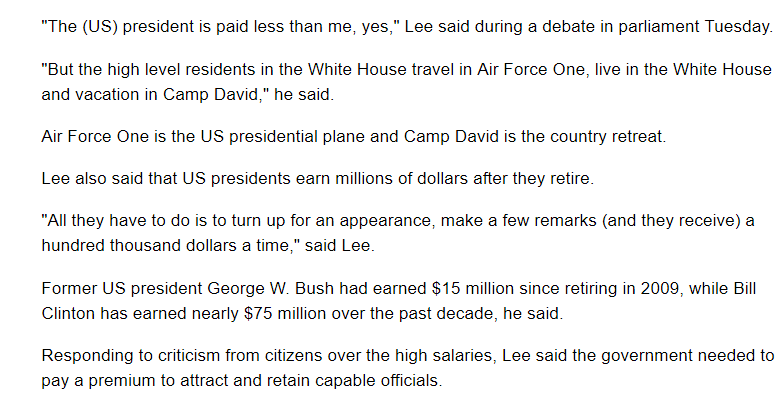
Source: (AFP) – Jan 17, 2012
The above report means PAP ministers has to be paid high salary as they have low or no income after retiring from politics.
On the contrary, it is a sad story and bad example as Wong, a former DPM, still has value to a bank. Lee Hsien Loong had not predicted a full picture in 2012.
Wong is certainly not the case, so do many other ministers and even former and current PAP members of parliament. Many of them hold directorships in listed companies on a “voluntary” basis.
Being a volunteer as CEO or director is not a bad option but a sad story to Singapore indeed.
Comments
Post a Comment